France meets second weekend of mass protests with 70,000 police, arrests 1,314
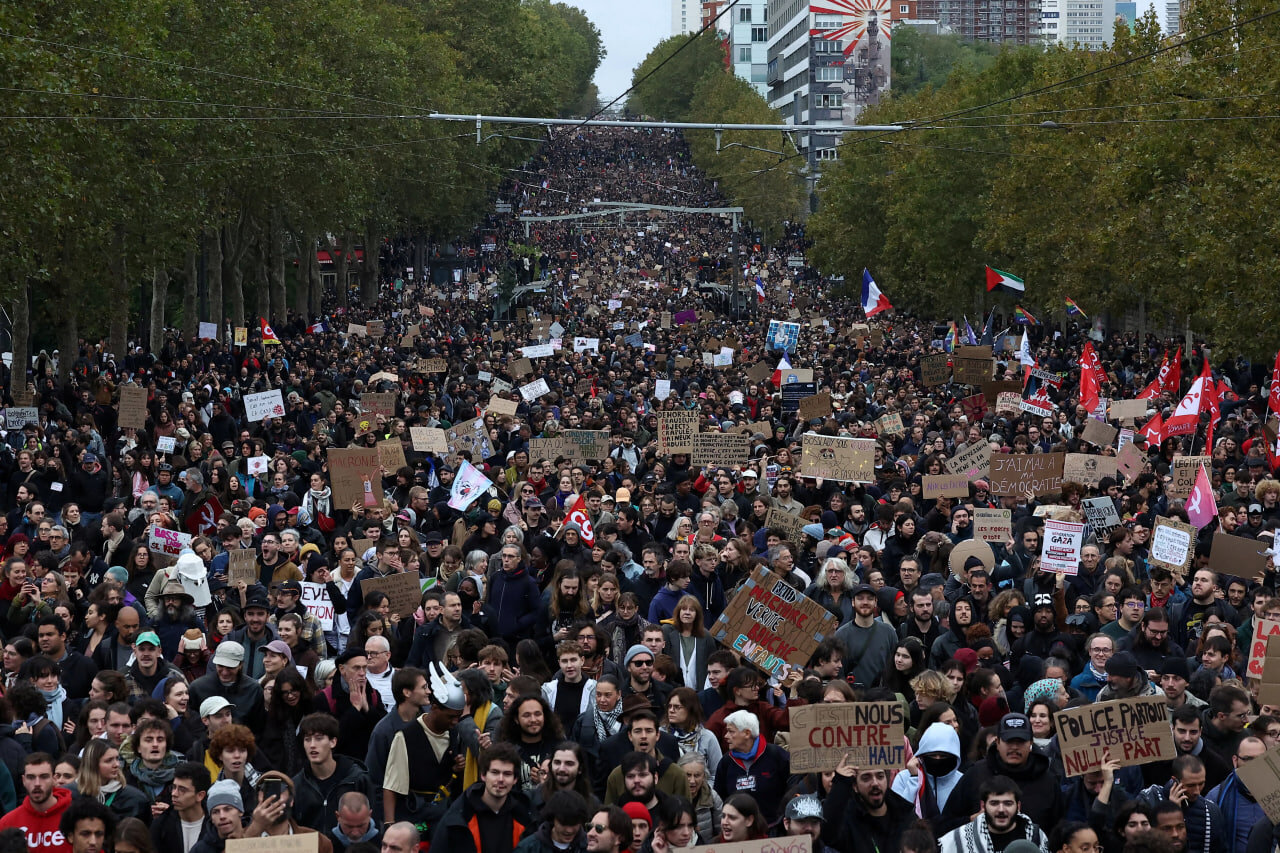
TEHRAN — French police arrested 1,314 people and sealed off city centers on Saturday as hundreds of thousands marched for a second consecutive weekend. Rather than addressing the root causes of the nationwide unrest, the government focused entirely on silencing the demonstrators through state repression.
The Interior Ministry initially said nearly 1,000 people had been detained, then raised the figure to 1,314, along with 75 fires and 24 looted shops.
It counted 410,000 marchers nationwide, 110,000 of them in Paris. Unions and activists say the real turnout was close to double. Whichever number is right, the crowds held steady against a deployment of 70,000 police officers and gendarmes, 20 percent more than a week earlier, backed by SWAT units, helicopters, armored vehicles and water cannon. Shopkeepers boarded up. Museums closed.
Interior Minister Laurent Nuñez defended the state’s security lockdown by noting that demonstrators had been successfully barred from staging unauthorized marches or entering city centers. For an official representing a self-proclaimed republic, the remarks offered a striking public confirmation of a strategy that kept citizens out of their own urban cores.
The government had already banned non-union demonstrations it labeled “illegitimate.”
The Paris march was mostly calm. Brass bands played, and grandparents walked beside students.
Trouble came at Porte de Vincennes, where the route ended. Masked groups threw bottles and stones, and police replied with tear gas, water cannon and stun grenades, then charged a wider crowd with batons.
Tear gas also kept demonstrators from the centers of Lyon, Lille, Montpellier, Nantes and Toulouse. Two people were seriously hurt in Clermont-Ferrand and Toulouse, one reportedly losing fingers.
French authorities claimed that investigations are already under way into children and other protesters maimed by explosive police weapons.
A plan to switch off the platforms
Two days before the march, Prime Minister Sébastien Lecornu wrote to Orange, SFR, Free and Bouygues Telecom, according to French outlet Blast.
He asked them to be ready to block TikTok, Instagram, Snapchat and X in the event of “urban violence,” and said he wanted the power to suspend access outright.
The operators answered that they lacked the capacity to do it quickly and that VPNs would defeat the block.
Paris has done this before. It cut off TikTok during the 2024 unrest in New Caledonia and lifted the ban only after several days. The pattern is familiar to anyone who has watched Western governments hypocritically denounce internet shutdowns in Iran and elsewhere, then reach for the same switch at home.
Whose violence gets attention
The destruction on the margins of Saturday’s marches was real, and shopkeepers are counting losses. Yet the official story leaves out who else showed up.
In Nice, prosecutors said 59 people were taken into custody, 11 of them suspected of extreme-right affiliation. Some were stopped in two vehicles carrying masks, gloves, gas sprays, and truncheons. Local media reported these groups going after peaceful demonstrators.
Others found a use for the chaos. Facing elections, Donald Trump and Benjamin Netanyahu seized on the riots to attack immigration, with Netanyahu blaming “Islamic extremists.”
Observers of the unrest describe the wreckers as mostly apolitical young men, many of immigrant origin but born in France. In Orléans, thousands marched against a congress held by Marine Le Pen’s National Rally, the party that polls and analysts currently position as the frontrunner for next year’s presidency.
A president with little left to offer
The revolt began in mid-September, when students aged 15 to 18 protested teacher shortages, leaking roofs and classrooms without enough chairs.
Teachers, parents and unions joined, and the grievances grew to cover the cost of living. On October 17, more than half a million people marched.
At least 2,700 were arrested, and Paris City Hall said 450 shops were damaged, 228 of them looted. Police later conceded they had misjudged the scale of the trouble.
Emmanuel Macron meets this with an approval rating of 15 percent, according to Ipsos BVA. He has struggled to pass budgets since losing his parliamentary majority in 2024, and Lecornu has called himself “the weakest prime minister of the Fifth Republic.”
Public debt is near 120 percent of GDP, and Macron’s one signature reform, a higher pension age, had to be frozen.
Jean-Luc Mélenchon, who marched in Paris, warned that protests will recur every week unless Macron gives in, and he pointed to possible industrial action on November 5.
The anger is not French alone. Tens of thousands marched in Madrid to defend pensions. Portuguese police cleared housing encampments in Lisbon and Porto. Catalan police arrested 128 people in Barcelona, and Italy sent hundreds of troops to Milan. Brussels police used a water cannon on students.
Jérôme Rodrigues, a leading voice of the yellow vests, summed up the standoff. “It’s not police shields that will provide an answer to French people struggling and unable to make ends meet,” he said, according to The Guardian’s Sunday report.
Leave a Comment